
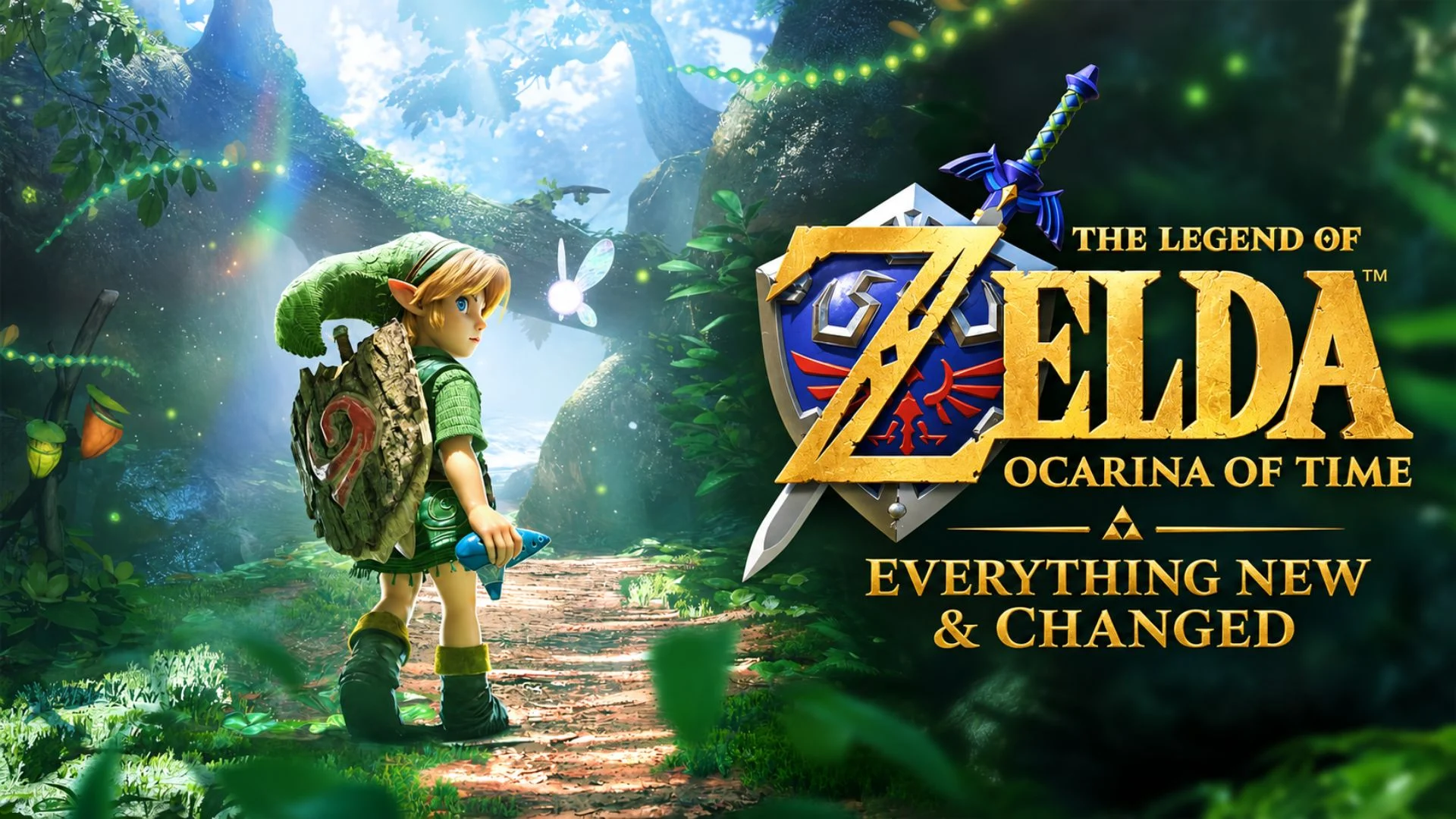

The Legend of Zelda: Ocarina of Time Remake is a ground-up rebuild of the 1998 Nintendo 64 game, not a port with sharper graphics. Nintendo has recreated Hyrule for Nintendo Switch 2 with new visuals, modern movement and camera controls, revised dungeon guidance, expanded story presentation, reworked audio, and several new support features. The guiding rule, however, was to preserve the original adventure rather than replace it.
This guide focuses on the confirmed differences players will notice. For launch date, price, platform, and purchase details, see our Ocarina of Time Complete FAQ. We also covered Nintendo’s original Switch 2 remake announcement.
| Feature | 1998 original | 2026 remake |
|---|---|---|
| Visuals | Nintendo 64 presentation | Completely rebuilt environments, characters, and materials |
| Jumping | Contextual auto-jump | Dedicated jump command |
| Movement | Walking and repeated rolling | Rolling plus a hold-to-dash option |
| Camera | Restricted views and recentering | Free camera control with the Right Stick |
| Cutscenes | Limited voice samples | Fully voiced, expanded cutscenes and more dialogue |
| Music | Original Nintendo 64 score | More than 150 reworked and newly composed pieces |
| Story guidance | Original navigation and hints | Threads of Time tracks progress and the next objective |
| Ocarina | Controller input | Controller input plus supported microphone interaction |
Built from the ground up, with the original experience as the target
Nintendo’s official product page calls the remake a classic tale “built from the ground up.” Program director Hiroki Taguchi offered a more technical explanation in Nintendo’s developer interview: after 28 years, the team chose to recreate everything instead of porting the original code and data and layering improvements on top.
That required the developers to rebuild individual features, compare the results with the Nintendo 64 game, and keep adjusting them. The goal was not to make Ocarina of Time behave like a completely different Zelda game. Director HokWai Ng described the team’s central philosophy as “the visuals may change, but the experience does not.” That principle explains why some systems have been modernized while the adventure’s structure remains familiar.
Completely rebuilt visuals and environments
The graphical change goes far beyond higher resolution. Nintendo says locations have been fully remodeled and material textures rebuilt in detail. The new Hyrule is denser, with more environmental information in explorable areas and carefully scaled landmarks intended to help players read the landscape.
The team did not pursue photorealism for its own sake. Art director Aya Shida said the original combined a beautiful but slightly dark Hyrule with colorful, unusual characters, creating a mysterious and almost dreamlike quality. The remake uses richer materials, lighting, vegetation, and object detail while trying to retain that tone.
Characters were also redesigned rather than simply rendered as more realistic versions of their old models. Nintendo studied the original cast’s silhouettes, movement, personality, and the impression each character created from a distance. Even clothing materials were reconsidered according to who might have made and worn them. For returning players, the intended effect is recognition without literal duplication.
The geography still uses separate maps for different areas instead of turning Hyrule into one seamless open world. That choice preserves the anticipation of moving from Kokiri Forest into Hyrule Field or entering another distinct location, even though every area now contains substantially more visual detail.
Jumping, dashing, and two ways to use Jump Attack
The most immediately noticeable control change is manual jumping. In the original, Link jumped automatically when the player moved toward an edge in a place where the game allowed it. The remake removes that contextual auto-jump and gives players a dedicated jump command that works throughout the world.
Nintendo made the change partly because players familiar with newer Zelda games could find the old restrictions arbitrary. Manual jumping also forced the team to reconsider terrain throughout Hyrule, including the slightly different jump distances of Young Link and Adult Link. It is a simple input change with consequences for how freely players can investigate the rebuilt spaces.
Traversal is faster too, but the old habit of rolling across Hyrule Field has not disappeared. Players can still use repeated Roll Attacks as they did in 1998, or hold the Roll Attack button to dash. Nintendo deliberately kept both because the rolling rhythm is part of the original game’s feel, while dashing provides the more direct movement option modern players expect.
Jump Attack follows the same dual-design approach. Players accustomed to newer Zelda controls can jump and then press attack. A second, single-button method recreates the immediacy of the original input. Neither option blocks the other, so returning players and newcomers can use the approach that feels natural.
Free camera control changes how Hyrule is read
The Nintendo 64 game used fixed or restricted camera behavior in many situations. The remake lets players freely rotate the view with the Right Stick, making it easier to inspect environments and notice points of interest from different angles.
Nintendo also acknowledged that camera freedom can create new navigation problems. If players rotate the view after a dungeon door opens, for example, they may lose track of the intended direction. The developers adjusted object placement and environmental cues to make routes more intuitive without removing the need to observe the room.
Ranged aiming has a new choice as well. According to the current product page, weapons including the Fairy Bow and Hookshot can use button aiming or motion controls, and the option can be customized in the settings.
Dungeon changes improve readability without replacing the puzzles
The dungeons have not been completely redesigned. Nintendo says their fundamental mechanisms remain intact, but some object placement and layout details have changed to make progression clearer. These are targeted readability adjustments, not an overhaul of every puzzle or room.
The same philosophy extends to encounters. Nintendo discussed making visual states easier to understand, such as clarifying when the first boss can be damaged. The purpose is to communicate the existing rules more cleanly rather than substitute a different battle concept.
How the Water Temple has changed
The Water Temple received specific attention because its complex structure and frequent equipment changes could leave players disoriented in the original. The remake makes item toggling easier, reducing the need to repeatedly interrupt navigation with menu use.
Some walls have also been changed to lattice-style structures. Seeing adjoining rooms through those walls gives players a better sense of the dungeon’s overall space and helps them maintain their bearings. Nintendo has emphasized that the core underwater concept and mechanisms remain, so these changes should not be read as a completely new Water Temple layout.
Threads of Time adds story and objective tracking
Threads of Time is a new system that records story progress and lets players check their next objective. As the adventure moves forward, it unlocks illustrations and passages that gradually join into a larger tapestry.
Nintendo describes it as both practical adventure support and a new way to follow the story, almost like a picture book assembled through play. It can help a player returning after time away understand what happened and what comes next, while giving families or players from different generations a shared record of the journey.
Expanded dialogue and fully voiced cutscenes
The remake expands cutscenes, adds more character dialogue, and fully voices those cinematic sequences. Nintendo has not described every line in the entire game as voiced, so the confirmed change is specifically the fuller dialogue and voiced cutscene presentation.
Preserving familiar character impressions mattered here too. The developers used blind auditions for the Japanese voices, hiding performer names so selections would be based on how closely each performance matched the established sound and feeling of the character. Iconic voice samples such as Navi’s familiar call were treated as part of the identity Nintendo wanted to protect.
More than 150 music pieces and a richer soundscape
The remake contains more than 150 pieces of background music. New cutscenes required new compositions, while returning themes were rearranged with attention to the scale and pacing of the original score. Grand pieces use the power of a full orchestra, but simpler cues deliberately retain smaller arrangements where that better fits the scene.
Some music recreates characteristics of the Nintendo 64 sound source and combines them with live orchestral performance. Nintendo did not simply reuse the console’s audio output; the sound team studied it as a reference and reproduced selected qualities to preserve the memory of those tracks.
The broader sound design has also been refreshed with layered environmental audio such as water, wind, leaves, insects, and birds. Nintendo recorded a real ocarina, including the breath behind the performance, and changes its resonance according to where Link plays it.
The ocarina can respond to humming and instruments
Traditional button controls remain available for the Fairy Ocarina and Ocarina of Time. The remake also uses the Nintendo Switch 2 microphone to recognize supported melodies Link has learned. Players can hum one of those melodies or play it on an actual instrument, prompting Link to perform the corresponding song in the game.
This is a focused musical interaction, not general voice control. The recognition is tied to learned ocarina melodies, and Nintendo presents it as a playful alternative rather than an easier way to progress.
Other new features in the rebuilt Hyrule
The day-and-night cycle now continues in places such as towns, where time behaved differently in the original. It is a small change, but it makes settlements feel connected to the same ongoing world simulation as the surrounding landscape.
The new Hall of Fallen Foes lets players discover more about enemies they have defeated.
ZELDA NOTES adds optional companion functions through the Nintendo Switch App on compatible smart devices. Today’s Record presents a chronological view of daily accomplishments and statistics. Gossip Quest asks players to locate places from hint images. Play Ocarina offers a touchscreen instrument with guided, automatic, and free-play options, while the Ocarina of Time Quiz draws from more than 2,000 questions. These app features supplement the game rather than replace its in-game navigation.
Existing Legend of Zelda amiibo provide in-game extras. Nintendo also plans Young Link and Young Zelda amiibo for 2027, with masks that evoke a retro graphical style as their announced special unlocks.
What Nintendo deliberately chose not to change
The remake’s additions sit inside the structure and identity of Ocarina of Time. Nintendo repeatedly emphasized the fundamental adventure, exploration and discovery, familiar character impressions, and core dungeon mechanisms. Separate map transitions remain, rolling remains, and several control additions sit alongside an original-style option.
The clearest example is a feature that did not survive development. Series producer Eiji Aonuma asked the team to test new warp points, hoping to reduce travel time across Hyrule. Nintendo removed them after playtesting showed that shortcuts caused players to miss the incidental discoveries that make the journey work.
That decision captures the remake’s dividing line. Systems were modernized when they made actions clearer, navigation more readable, or the world easier to inhabit. Changes were pulled back when they weakened the exploration and carefully paced discovery at the center of the 1998 design.
This article reflects Nintendo’s official information available as of November 5, 2026.
Which remake change do you think will make the biggest difference to your journey through Hyrule?

Comments
No comments yet. Be the first to share your thoughts.